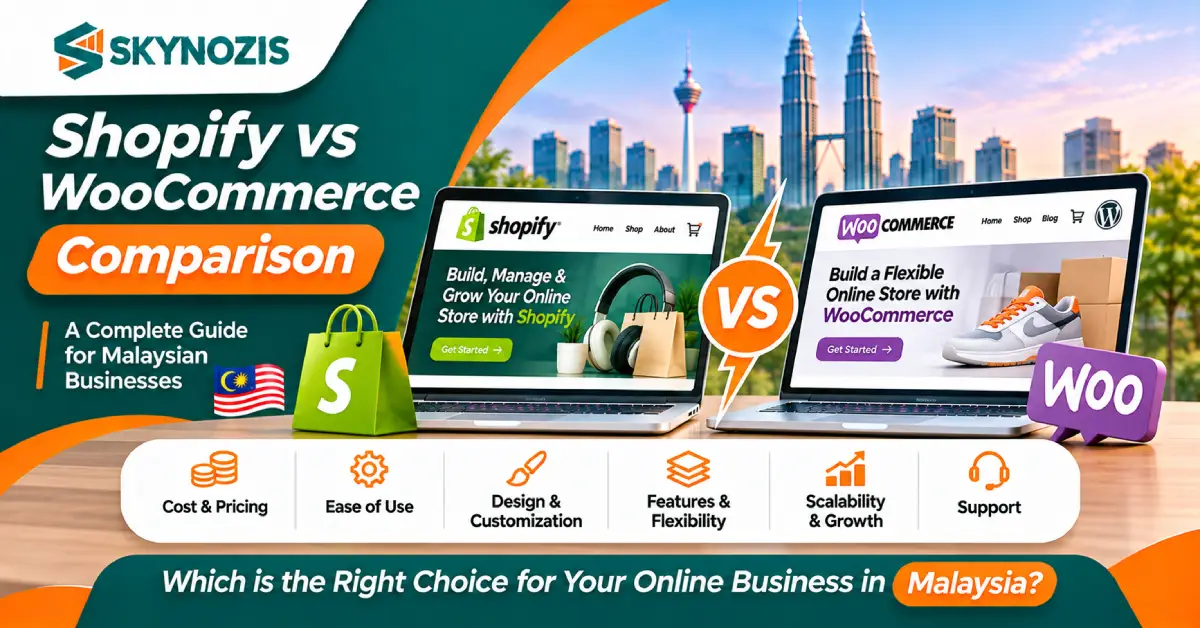
Choosing the right eCommerce platform is an important decision when starting an online business. Whether you are launching a new online store, expanding an existing retail business or planning to sell internationally, your website platform can influence your operating costs, flexibility and future growth.
Two popular options are Shopify and WooCommerce. Both platforms allow businesses to sell products online, manage orders and create professional shopping experiences. However, they work differently and offer different levels of control, customisation and management.
So, when comparing Shopify vs WooCommerce, which platform is better for your business?
The answer depends on your budget, technical requirements, business operations and long-term objectives. In this guide, we compare both platforms to help businesses in Malaysia and Singapore make an informed decision.
What Is Shopify?
Shopify is a hosted eCommerce platform that allows businesses to create and manage online stores without managing their own conventional web hosting infrastructure.
It provides an integrated environment for managing products, orders, payments, inventory and storefront design.
Key Shopify features include:
- Hosted online store infrastructure.
- Ready-made website themes.
- Product and inventory management.
- Shopping cart and checkout functionality.
- Payment gateway integrations.
- App marketplace for additional features.
- Sales channel integrations.
- International selling capabilities.
Shopify is particularly suitable for entrepreneurs and businesses that prefer a managed platform with a centralised administration dashboard.
You can explore the official Shopify platform to understand its available features.
What Is WooCommerce?
WooCommerce is an open-source eCommerce plugin built for WordPress. It transforms a WordPress website into an online store, allowing businesses to sell physical products, digital products and other types of offerings.
Unlike Shopify, WooCommerce requires you to arrange suitable web hosting and manage the underlying WordPress environment.
Its major features include:
- Open-source eCommerce functionality.
- Customisable website themes.
- Product and inventory management.
- Flexible payment gateway integrations.
- Shipping and delivery extensions.
- Custom plugin development.
- SEO and content management through WordPress.
- Greater control over website infrastructure.
WooCommerce is suitable for businesses that want greater control over their website and prefer the flexibility of the WordPress ecosystem.
Read more about the platform at WooCommerce.
Shopify vs WooCommerce: Main Differences Explained
Although both platforms support online selling, their underlying technologies and management approaches are different.
| Comparison | Shopify | WooCommerce |
|---|---|---|
| Platform type | Hosted eCommerce platform | Open-source WordPress plugin |
| Hosting | Included in subscription | Purchased separately |
| Initial setup | Generally straightforward | Requires WordPress and hosting setup |
| Website customisation | Themes, apps and supported custom development | Themes, plugins and custom development |
| Product management | Built-in | Built-in |
| Payment integration | Shopify-supported providers | Multiple compatible gateways |
| SEO | Built-in SEO features and apps | WordPress SEO plugins and customisation |
| Maintenance | Platform infrastructure managed by Shopify | Merchant or developer manages WordPress environment |
| Scalability | Supports growing businesses | Scales with suitable hosting and architecture |
| Technical control | More platform-managed | Greater infrastructure and code control |
Neither platform is automatically better for every business. Your requirements should determine the most appropriate solution.
Website Design and Customisation
Your online store should reflect your brand identity and provide a convenient shopping experience.
Shopify offers ready-made themes that businesses can customise using its theme editor. More advanced storefront changes can be implemented through Shopify’s development tools and supported integrations.
WooCommerce provides greater flexibility through the WordPress theme and plugin ecosystem. Developers can customise product layouts, shopping experiences, website structure and business-specific functionality.
For example, a fashion retailer in Kuala Lumpur may want custom product filters, size selection and promotional landing pages. A wholesale business in Penang may require customer-specific pricing and enquiry functionality.
Both platforms can support these requirements, although the implementation approach and limitations differ.
If you want complete control over your WordPress website, WooCommerce offers an extensive customisation environment.
Cost and Ongoing Expenses
Cost is an important consideration when choosing an eCommerce platform.
Shopify follows a subscription-based model. You pay for your selected plan, while additional expenses may include premium themes, paid applications, payment processing and professional development.
WooCommerce itself is free to download and use. However, you need to consider hosting, domain registration, premium extensions, development and maintenance.
Typical expenses include:
Shopify expenses
- Monthly or annual subscription.
- Premium theme, if required.
- Paid applications.
- Payment processing fees.
- Additional transaction fees where applicable.
- Custom development.
WooCommerce expenses
- Website hosting.
- Domain registration.
- Premium themes and plugins.
- Payment gateway processing.
- Website development.
- Maintenance, backups and security.
Therefore, comparing Shopify vs WooCommerce cost requires looking beyond the initial subscription or free plugin.
A simple WooCommerce website may be economical, while a complex WooCommerce project can require considerable development and maintenance. Similarly, Shopify costs can increase as you add paid applications and advanced requirements.
Payment Gateways for Malaysia and Singapore
Payment availability is particularly important for businesses targeting customers in Malaysia and Singapore.
Shopify and WooCommerce support payment integrations, but merchant eligibility and available providers depend on the business’s registered country.
For Malaysian businesses, suitable payment gateway options may include providers supporting FPX online banking, DuitNow and card payments.
For Singapore businesses, payment requirements may include cards, PayNow and other supported local payment methods.
There is an important platform-specific distinction:
- Shopify Payments is supported for eligible Singapore businesses but is not currently listed for Malaysian businesses.
- WooPayments is available to eligible Singapore-based merchants but is not currently listed for Malaysian merchants.
- WooCommerce can integrate with other third-party payment gateways independently of WooPayments.
Always verify the payment provider’s current country eligibility, transaction fees and integration compatibility before selecting a platform.
This is particularly important for businesses operating across Kuala Lumpur, Johor Bahru, Penang and Singapore.
SEO and Search Engine Visibility
Search engine optimisation is important for businesses that want customers to discover their products through Google.
Both platforms provide SEO capabilities, but their implementation approaches differ.
Shopify provides built-in SEO features such as editable page titles, meta descriptions, canonical tags and sitemap functionality. Additional SEO applications can provide further capabilities.
WooCommerce benefits from WordPress’s content management flexibility and can be extended using SEO plugins.
You can manage:
- Product and category page metadata.
- SEO-friendly URLs.
- Product descriptions.
- Image ALT attributes.
- Internal linking.
- XML sitemaps.
- Structured data.
- Blog content and landing pages.
The choice between Shopify SEO vs WooCommerce SEO should depend on your content strategy and technical requirements.
Neither platform guarantees higher Google rankings. Content quality, website performance, technical SEO, backlinks and search intent all influence organic visibility.
Security, Maintenance and Performance
Website security and performance affect customer confidence and the shopping experience.
Shopify manages its hosted infrastructure, reducing the amount of server-level maintenance required from store owners. However, businesses remain responsible for account security, application selection and appropriate data-handling practices.
WooCommerce provides more control over hosting and website infrastructure. However, businesses must maintain WordPress, themes, plugins, backups and security configurations.
For either platform, consider:
- SSL/TLS encryption.
- Secure administrator access.
- Regular software updates.
- Reliable backups.
- Payment security.
- Image optimisation.
- Mobile performance.
- Checkout testing.
WooCommerce performance depends heavily on hosting quality, theme architecture, plugins and database optimisation. Shopify performance is also affected by theme implementation, third-party scripts and applications.
Which Platform Is Better for Your Business?
Your business requirements should guide the final decision.
Choose Shopify if:
- You want a managed eCommerce platform.
- You prefer straightforward store administration.
- You want hosting included.
- You need a centralised product and order management system.
- You prefer using ready-made themes and applications.
- You want to minimise server maintenance.
Choose WooCommerce if:
- You already have a WordPress website.
- You want greater control over website functionality.
- You need customised business workflows.
- You prefer an open-source platform.
- You require deeper integration with WordPress content and SEO.
- You want control over hosting and website infrastructure.
Need Help Choosing Your eCommerce Platform?
Not sure whether Shopify or WooCommerce is suitable for your business?
Skynozis helps businesses evaluate their website requirements and develop professional eCommerce solutions with the right design, functionality and integrations.
Can You Migrate Between Shopify and WooCommerce?
Yes. Businesses can migrate their online stores between Shopify and WooCommerce.
For example, a retailer may initially choose Shopify for its managed environment but later require WordPress-based content management and customised functionality.
Similarly, a WooCommerce business may consider Shopify to simplify infrastructure management.
Migration may involve transferring:
- Product information.
- Product categories.
- Customer records.
- Order history.
- Product images.
- Website content.
- URL structures and redirects.
Not every element transfers automatically. Payment information, customer passwords, application data and custom functionality may require special handling or reconfiguration.
Before migration, prepare a detailed plan covering data integrity, SEO redirects, integrations and checkout testing.
Why Work with a Professional eCommerce Development Company?
Selecting a platform is only part of building a successful online store. Your website also needs professional design, proper technical configuration and a convenient shopping experience.
A professional development partner can help you plan the website structure, configure products, integrate payment gateways and implement the functionality your business requires.
At Skynozis, our eCommerce development capabilities include WooCommerce and WordPress eCommerce solutions, custom product pages, checkout functionality, payment gateway integrations and inventory management.
We also provide Shopify website development for businesses looking for a managed eCommerce platform.
Our objective is to build online stores around your business requirements rather than forcing every business into the same website structure.
Ready to Build Your Online Store?
Whether you prefer Shopify’s managed environment or WooCommerce’s flexible WordPress ecosystem, Skynozis can help you plan and develop your online store.
Discuss your requirements with our team and get a development approach suited to your business.
Frequently Asked Questions
Shopify is generally easier for beginners because hosting, store management and many essential eCommerce features are available within one platform. WooCommerce requires WordPress and hosting configuration.
WooCommerce has no core plugin subscription fee, but hosting, premium extensions, maintenance and development can add costs. Shopify has recurring subscription fees and potentially additional application and payment expenses. Compare the total cost of ownership rather than just the starting price.
Yes. Malaysian businesses can use WooCommerce and integrate compatible third-party payment gateways based on their business and provider eligibility.
Yes. Eligible Singapore businesses can use Shopify, including Shopify Payments subject to the applicable verification and eligibility requirements.
Both platforms support SEO. WooCommerce offers extensive WordPress content and plugin flexibility, while Shopify includes built-in SEO capabilities. Rankings depend on the quality of implementation and overall SEO strategy.
Yes. Both platforms support customisation. Shopify uses its themes, development tools and app ecosystem, while WooCommerce supports WordPress themes, plugins and custom PHP development.
Yes. Skynozis provides Shopify website development and WooCommerce-based eCommerce development. We can help you choose a suitable platform based on your project requirements.
Final Thoughts: Make the Right eCommerce Platform Choice
Choosing between Shopify and WooCommerce is not simply about selecting the most popular platform. It is about understanding how each solution fits your business operations, budget, technical requirements and future plans.
Shopify is a strong option for businesses that prefer managed infrastructure and convenient store administration. WooCommerce is a suitable choice for businesses that need WordPress flexibility, greater control and customised functionality.
Before making a decision, evaluate your payment requirements, design expectations, integrations, maintenance responsibilities and long-term objectives.
If you are planning a new online store or upgrading an existing eCommerce website, Skynozis can help you choose the right approach and turn your business requirements into a professional online shopping experience.
Let’s build an eCommerce website that supports your business growth.