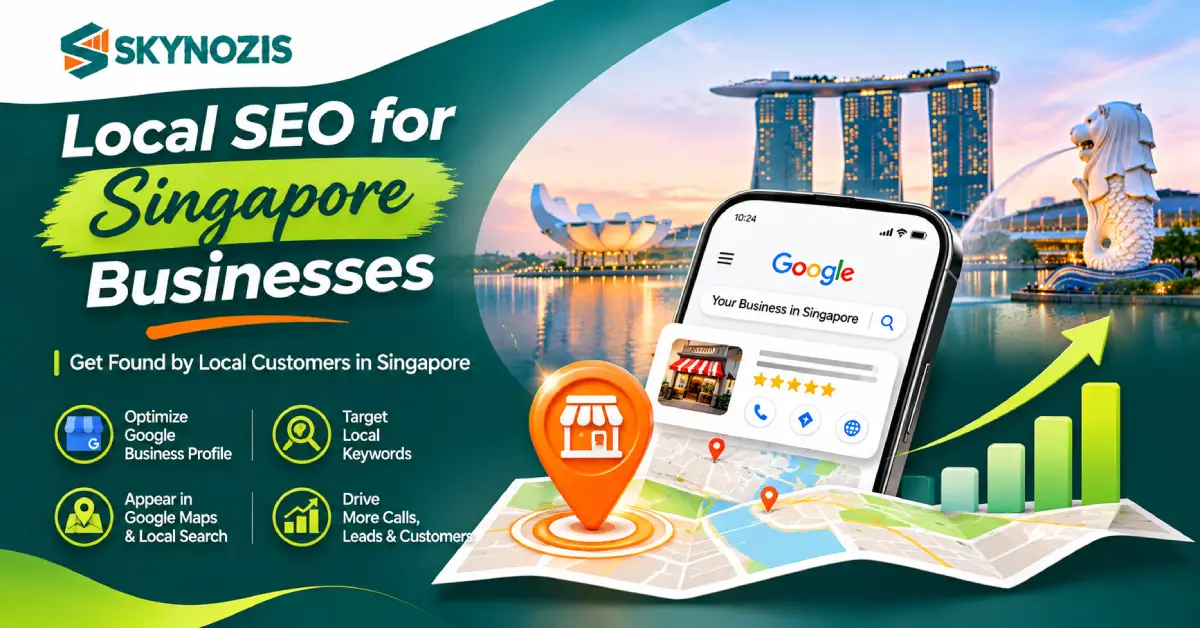
When someone searches Google for a nearby restaurant, accounting firm, dental clinic or home renovation service, they usually want to find a business they can contact or visit without spending too much time searching. If your business does not appear in those results, potential customers may choose a competitor instead.
For businesses operating in Singapore, appearing in relevant local searches is an important part of building an online presence. Whether your company serves customers in Tampines, Jurong, Orchard, Woodlands or the Central Business District (CBD), your website and business information should help people understand what you offer and where you operate.
This is where local SEO Singapore strategies become valuable. By improving your Google Business Profile, website content, local relevance and online reputation, you can make it easier for nearby customers to discover your business.
In this guide, we explain practical local search optimisation techniques that Singapore businesses can use to improve visibility and generate relevant enquiries.
What Is Local SEO and Why Does It Matter in Singapore?
Local SEO is the process of improving your business’s visibility in location-related search results on Google Search and Google Maps.
For example, a person searching for an accountant in Tampines, a renovation contractor in Jurong or a dental clinic near Orchard Road is looking for a service connected to a particular location.
Google aims to show relevant businesses based on three main factors:
- Relevance: How closely your business matches what the customer searches for.
- Distance: How far your business is from the searcher or the location mentioned in the search.
- Prominence: How well-known your business is, based on information such as reviews, links and other online signals.
These are the main factors Google identifies in its official local ranking guidance.
For Singapore SMEs, this means that having a website alone may not be sufficient. Your business information, service pages, customer feedback and online presence should work together to help customers find and evaluate your services.
How Can Singapore Businesses Improve Local Search Visibility?
Optimise Your Google Business Profile
Your Google Business Profile is one of the most important starting points for local search visibility.
It allows eligible businesses to display useful information directly in Google Search and Google Maps, including their business name, address or service area, operating hours, contact information, website and customer reviews.
To improve your profile:
- Use your genuine business name.
- Select the most relevant primary business category.
- Add accurate business contact information.
- Provide your actual business address or eligible service area.
- Update operating hours and holiday schedules.
- Describe your products and services accurately.
- Upload genuine business photographs.
- Keep your website and contact details updated.
For example, a plumbing company serving customers in Bedok and Pasir Ris should accurately describe its services and eligible service areas instead of claiming to have multiple offices.
Google requires businesses to represent their real-world operations accurately. Do not create duplicate profiles or use virtual offices simply to target additional locations.
Read Google’s official Business Profile guidelines.
Target Location-Based Keywords Naturally
Your potential customers may search for services using different location names.
A customer looking for a web design company might search for:
- Website design company Singapore
- SEO services in Singapore
- WordPress developer in Tampines
- eCommerce development Singapore
- Digital marketing agency near Orchard
Understanding these search patterns helps you plan website content around genuine customer requirements.
Conduct local keyword research using Google Search suggestions, Google Search Console and keyword research tools.
You should also consider neighbourhoods, business districts and planning areas where your company genuinely operates.
Avoid creating multiple pages by simply replacing one location name with another. Each location page should offer meaningful information, relevant examples and genuinely useful local context.
Create Dedicated Service and Location Pages
A common website problem is trying to explain every service and target location on one page.
A better approach is to organise your website around individual services and relevant service areas.
For example, an accounting firm might have separate pages for:
- Corporate tax services.
- Bookkeeping services.
- Payroll management.
- Accounting services for SMEs.
If the business genuinely serves multiple Singapore areas, useful location-specific content can explain service availability, customer requirements and relevant local considerations.
Each page should have a unique title, clear headings, useful content and a relevant call to action.
This approach helps search engines understand the relationship between your services and the customers you want to reach.
Build Genuine Customer Reviews and Respond to Feedback
Customer reviews can influence how potential customers evaluate a business.
Before contacting a service provider, people often compare ratings, read customer experiences and check how the business responds to feedback.
Develop a simple process for requesting honest reviews after completing a service or project.
You can:
- Share your Google review link with customers.
- Send a follow-up email after completing a project.
- Display a QR code at your business premises.
- Respond professionally to positive and negative feedback.
- Address genuine customer concerns.
Never purchase reviews or offer rewards in exchange for positive ratings. Google requires reviews to reflect genuine customer experiences and prohibits incentivised review manipulation.
A professional response to customer feedback also demonstrates that your business values its customers.
Maintain Consistent Business Information Across the Internet
Your business name, address and phone number should be accurate and consistent across your website, Google Business Profile and relevant business directories.
This information is commonly referred to as NAP (Name, Address and Phone Number).
For example, if your website displays one telephone number but your business directory listings show an outdated number, customers may struggle to contact you.
Review your business information across:
- Google Business Profile.
- Your official website.
- Relevant Singapore business directories.
- Industry association websites.
- Social media business profiles.
- Genuine business partner listings.
Focus on relevant and trustworthy platforms rather than submitting your website to hundreds of unrelated directories.
Improve Website Performance and Mobile Experience
Many customers use smartphones to search for nearby businesses, compare services and make enquiries.
If your website loads slowly, displays poorly on mobile devices or makes contact information difficult to find, potential customers may leave.
Your website should include:
- Responsive mobile-friendly layouts.
- Fast-loading pages and optimised images.
- Clear service descriptions.
- Easy-to-find contact information.
- Clickable telephone and email links.
- Convenient enquiry forms.
- Secure HTTPS connections.
Use Google PageSpeed Insights to identify technical performance problems.
A well-structured website supports your local search strategy by providing useful information after visitors discover your business through Google.
Publish Useful Content for Your Local Audience
Publishing helpful content can attract people who are researching services before making a purchasing decision.
Instead of publishing generic articles, answer questions that your potential customers actually ask.
For example:
A renovation company could publish a guide explaining renovation planning considerations for HDB flats, while an accounting firm could create content about common tax and bookkeeping questions faced by Singapore SMEs.
A professional services company might publish case studies, service explanations and industry-specific guides.
Include genuine local context, accurate information and relevant internal links to your service pages.
The objective is to demonstrate your knowledge and help readers make informed decisions, rather than inserting location keywords into every paragraph.
Want More Local Customers to Discover Your Business?
Having a website is only one part of building a strong online presence. Your business also needs the right SEO strategy to reach people actively searching for your services.
Skynozis provides SEO optimisation solutions, including local SEO, keyword research, technical SEO, on-page optimisation and content strategy.
Track Your Local SEO Performance
mproving local search visibility requires ongoing monitoring. Do not evaluate your results only by checking whether your business appears in Google for one particular search.
Use the following tools to understand how your website and business profile are performing:
Google Search Console
Review search impressions, clicks, queries, average positions and indexing issues. You can identify which location-related searches are bringing visitors to your website.
Google Analytics 4
Measure organic traffic, engaged sessions, enquiry form submissions and other important conversion actions.
Google Business Profile Performance
Where available, review customer interactions such as calls, website clicks and direction requests.
Compare performance over time to identify which services, pages and search queries are generating useful enquiries.
Common Local SEO Mistakes Singapore Businesses Should Avoid
Even businesses with established websites can make mistakes that limit their local search visibility.
Some common problems include:
- Creating duplicate Google Business Profiles.
- Adding unnecessary keywords to the business name.
- Using inaccurate business addresses or service areas.
- Publishing duplicate location pages with little useful information.
- Purchasing backlinks from irrelevant websites.
- Buying fake customer reviews.
- Ignoring negative customer feedback.
- Leaving outdated contact information online.
- Publishing content without considering customer search intent.
Avoid shortcuts that may damage your online reputation or violate Google’s guidelines. Focus on accurate information, useful content and genuine customer experiences.
How Long Does Local SEO Take to Show Results?
Local SEO is an ongoing process, and results depend on factors such as competition, business location, website condition, online reputation and the quality of your optimisation work.
Some improvements to business information may be reflected relatively quickly, while building stronger prominence, earning relevant links and improving organic visibility can take considerably longer.
There is no guaranteed ranking position or fixed timeline.
A practical approach is to establish a performance baseline, implement improvements and review results regularly. Focus on qualified enquiries, calls and customer actions rather than rankings alone.
Why Choose Skynozis for SEO Optimisation?
Skynozis helps businesses strengthen their digital presence through website development and SEO solutions.
Our SEO capabilities include:
- SEO audits and keyword research.
- On-page SEO optimisation.
- Technical SEO improvements.
- Local SEO and Google Business Profile optimisation.
- SEO-focused website content.
- Website performance optimisation.
- Internal linking and website structure improvements.
- SEO reporting and performance monitoring.
We understand that every business has different audiences, services and growth objectives. Our approach focuses on building an SEO strategy around your actual business requirements.
Whether you are a startup, professional services company, retailer or established SME targeting customers in Singapore, we can help you identify opportunities to improve your online visibility.
Frequently Asked Questions
Local SEO is the process of improving a business’s visibility in location-related Google Search and Google Maps results. It involves optimising business information, website content, customer reviews and relevant online references.
Yes. Eligible businesses can use Google Business Profile to display their services, location or service area, operating hours, contact details and customer reviews in Google Search and Maps.
Start with an accurate and complete Google Business Profile, choose relevant categories, maintain genuine customer reviews, publish useful website content and build relevant online authority. Google primarily considers relevance, distance and prominence.
A Google Business Profile can help eligible businesses appear in local results without a website. However, a professional website provides additional space to explain services, answer customer questions, demonstrate credibility and generate enquiries.
Yes, if it genuinely serves those areas. Create useful location-specific website content where appropriate, explain service availability accurately and avoid creating thin or duplicate location pages.
Pricing varies depending on keyword research, competition, website condition, content requirements, technical improvements and ongoing optimisation. Request a proposal with a clear breakdown of deliverables rather than relying on unsupported fixed-price estimates.
Conclusion: Make Your Business Easier to Discover Online
Customers are already searching online for products and services in their neighbourhoods. Your business needs to provide accurate information, useful website content and a trustworthy online presence to compete for their attention.
Start by improving your Google Business Profile, researching location-based search terms, building relevant service pages and collecting genuine customer feedback.
A consistent local search strategy can help Singapore businesses reach more relevant audiences and create additional opportunities for enquiries.
Ready to improve your local search visibility?
Contact Skynozis to discuss an SEO strategy that supports your business goals.
Website: https://skynozis.com/
Email: info@skynozis.com