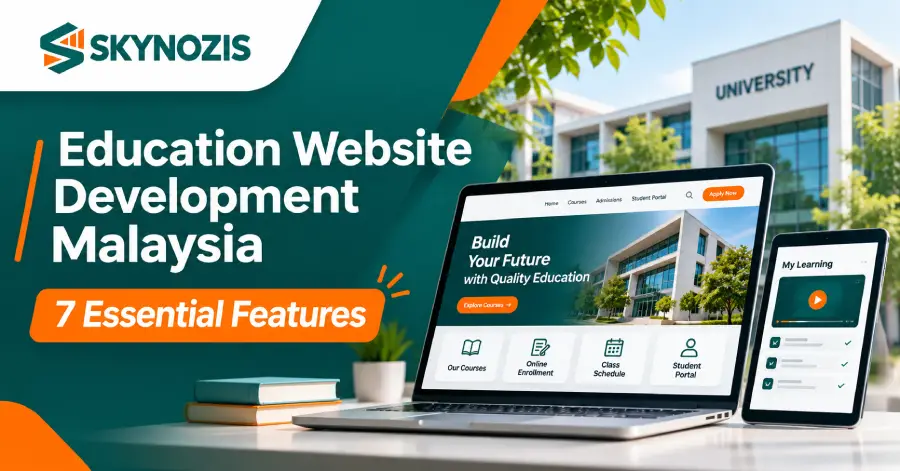
The way students discover educational institutions, explore courses and register for programmes has changed significantly. Today, students and parents expect to find course information, admission requirements, registration options and important updates online without having to visit an institution physically.
For schools, colleges, universities and professional training centres, having a basic informational website may no longer be sufficient. An effective education website should provide a convenient digital experience where visitors can explore programmes, submit applications, register for courses and access learning resources.
This is where education website development Malaysia becomes valuable. A professionally developed education website can bring course information, student registration, communication and learning management into one organised digital platform.
Let’s explore the essential features educational institutions should consider when developing a modern website.
1. Professional Website Design That Builds Trust
Your website is often the first interaction prospective students and parents have with your institution. A professional design helps communicate credibility, educational quality and the programmes you offer.
An effective education website should include:
- A clear homepage introducing your institution.
- About us and accreditation information.
- Course and programme listings.
- Faculty and trainer profiles.
- Campus facilities and infrastructure.
- Student testimonials and achievements.
- Contact information and enquiry forms.
The design should also provide straightforward navigation so visitors can find important information without unnecessary steps.
For institutions in Kuala Lumpur, Selangor, Penang and Johor Bahru, a well-structured website can help present their programmes to students searching for educational opportunities online.
A responsive design is equally important because students may access the website through smartphones, tablets and desktop computers.
2. Online Course Registration System
One of the most valuable features of an educational website is an online course registration system.
Traditional registration processes often involve phone calls, paper forms, emails and manual data entry. These processes can become difficult to manage when an institution receives enquiries and applications from multiple locations.
With an online course registration system, prospective students can:
- Browse available courses and programmes.
- Check course descriptions and eligibility requirements.
- Select their preferred programme.
- Complete registration forms online.
- Upload required documents.
- Submit applications through the website.
- Receive registration confirmation.
Institutions can also manage submitted applications through an organised administrative dashboard.
For example, a professional training centre in Selangor offering multiple certification programmes could allow students to select a course, complete their details and submit an application directly through its website.
This makes the registration process more convenient for students while reducing repetitive administrative work for staff.
Planning to Build an Education Website?
Give your students a better online experience with a professional education website. From course registration forms to student portals, Skynozis helps businesses and educational institutions build customised digital solutions.
Let’s discuss your education website requirements and turn your ideas into a functional platform.
3. Student Portal for Better Communication
A student portal provides registered students with a dedicated area to access information related to their studies.
Instead of relying entirely on emails or messaging applications, institutions can provide a centralised platform where students log in and view relevant academic information.
Depending on institutional requirements, a student portal may include:
- Student profile management.
- Course enrolment details.
- Class schedules and timetables.
- Learning materials and downloadable documents.
- Assignment information.
- Examination schedules.
- Academic announcements.
- Fee and payment information.
A well-planned student portal development Malaysia project should consider different access levels for students, lecturers, administrators and other authorised users.
For example, students should only access their own academic information, while lecturers may need additional permissions to manage course materials or communicate with enrolled students.
The portal should be designed around the institution’s actual administrative and academic workflows rather than adding features that are not necessary.
4. Learning Management System (LMS) Integration
For institutions offering online courses or blended learning programmes, integrating a Learning Management System (LMS) can significantly improve the learning experience.
An LMS provides a structured environment for managing digital learning activities.
Depending on the selected platform and integration requirements, useful capabilities may include:
- Online lessons and recorded videos.
- Course modules and learning materials.
- Assignments and assessments.
- Student progress tracking.
- Online quizzes and examinations.
- Course completion records.
- Instructor and student communication.
For example, an institution could use its main website to promote courses and accept registrations while an integrated LMS manages enrolled students’ learning activities.
This approach is particularly useful for training providers and institutions offering programmes to students across different Malaysian states.
When planning LMS integration Malaysia, institutions should evaluate platform compatibility, user management, authentication, data synchronisation and future scalability.
5. Course Management and Administrative Dashboard
Managing multiple courses through spreadsheets and separate documents can become complicated as an institution expands.
A centralised administrative dashboard helps staff manage important website activities from one location.
A custom education website may include administrative features such as:
- Create and update courses.
- Manage course categories.
- Set registration availability.
- Review student applications.
- Manage student accounts.
- Publish announcements.
- Upload course materials.
- Monitor registration records.
Different staff members can receive different permissions based on their responsibilities.
For example, an administrator may manage all courses and registrations, while an individual trainer may only update the learning materials assigned to their programmes.
This type of functionality can be developed through custom WordPress development or a tailored web application, depending on the institution’s requirements.
Need a Custom Student Portal or LMS Integration?
Managing courses, student registrations and learning resources doesn’t have to be complicated. Our custom WordPress and web development solutions can help you build a platform around your institution’s specific requirements.
Whether you need a student portal, custom dashboard or third-party API integration, let’s discuss the right solution for your project.
6. Secure Payment and Registration Process
If an institution offers paid courses, its website should provide a convenient and reliable payment experience.
Students should be able to understand course fees, registration requirements and available payment options before completing their applications.
Depending on the payment provider and institutional requirements, the website may support:
- Online payment gateway integration.
- Course fee information.
- Registration payment confirmation.
- Payment status tracking.
- Automated email notifications.
- Downloadable receipts.
Security should be considered throughout the registration and payment process.
Institutions should use trusted payment providers, secure website connections, appropriate access controls and responsible handling of personal information.
For websites collecting student information, clear privacy information and suitable data protection practices are also important.
7. SEO and Mobile-Friendly Website Structure
Developing a feature-rich education website is only part of the process. Students must also be able to discover the institution through search engines.
A search-engine-friendly website structure helps search engines understand the institution’s services, courses and important pages.
For better online visibility, consider:
- Unique SEO titles and meta descriptions.
- Proper heading structure.
- Descriptive course and programme pages.
- Search-friendly URLs.
- Optimised images with descriptive ALT text.
- Fast-loading website pages.
- Mobile-responsive layouts.
- Relevant internal links.
Educational institutions should also create location-relevant content where appropriate.
For example, institutions serving Kuala Lumpur, Penang, Johor Bahru and Selangor can develop useful location-specific information based on their actual campus locations and service areas.
A professional website should combine useful educational content with technical SEO practices rather than simply repeating keywords throughout the pages.
Why Choose Custom Education Website Development?
Every educational institution has different requirements.
A small training centre may only need course listings, registration forms and enquiry management. A university or larger educational organisation may require student portals, LMS integrations, multiple user roles and advanced administrative functionality.
Choosing the right development approach is therefore important.
With professional education website development Malaysia, institutions can plan a website around their specific operational needs.
At Skynozis, we provide website design and development, custom WordPress development, custom functionality, API integrations and SEO optimisation.
Our development approach focuses on creating responsive, user-friendly and scalable websites that support business and organisational objectives.
Whether you are establishing a new training centre, upgrading an existing school website or planning a custom education platform, the right website architecture can provide a strong foundation for future growth.
Frequently Asked Questions
An education website should include course listings, programme details, online registration, enquiry forms, student information and contact details. Advanced platforms may also include student portals, LMS integration and administrative dashboards.
Yes. A student portal can be developed using suitable WordPress functionality, custom plugins or external platform integrations, depending on the required features and security requirements.
Yes. An online registration system can allow students to select courses, complete application forms, upload documents and receive confirmation.
Yes. An education website can integrate with an LMS to provide access to online lessons, assignments, assessments and student progress information.
Yes. A custom solution can be designed around the actual requirements of a training centre, starting with course listings and registration before expanding into more advanced functionality.
Build a Better Digital Experience for Your Students
An education website should do more than display information. It should make it easier for students to discover courses, register for programmes and access important learning resources.
If you are planning to develop a new education website or upgrade your existing platform, Skynozis can help you create a professional solution tailored to your institution’s requirements.
Looking for professional website design and development in Malaysia?
Visit https://skynozis.com/ or contact info@skynozis.com to discuss your project.