
Running a physical retail shop has always involved attracting customers, managing products and maintaining good relationships with buyers. However, shopping habits are changing. Many customers now prefer browsing products online, comparing prices and placing orders without visiting a physical store.
For Malaysian retailers, this creates an opportunity to expand beyond traditional shop locations and reach customers through digital channels.
Whether you operate a fashion boutique, electronics shop, beauty store, furniture business or lifestyle brand, having your own online store can make your products accessible to a wider audience.
This is where online store development Malaysia becomes valuable. A professionally developed eCommerce website allows retailers to display products, accept online payments, manage orders and build a direct relationship with customers.
Let’s explore how your retail business can move from a physical shop to a successful online store.
1. Build Your Own Online Store and Expand Your Customer Reach
A physical shop mainly serves customers who can visit your location. An online store allows people to explore your products from different locations without travelling to your premises.
For example, a fashion retailer operating in Kuala Lumpur can display its products online and receive enquiries or orders from customers in Selangor, Penang, Johor Bahru and other parts of Malaysia.
A professional online shopping website Malaysia solution should include:
- Attractive homepage and product categories.
- Individual product pages.
- Product descriptions and pricing.
- Product photographs and galleries.
- Shopping cart and checkout.
- Customer account registration.
- Contact and enquiry information.
Your website should also reflect your brand identity through consistent colours, typography, imagery and navigation.
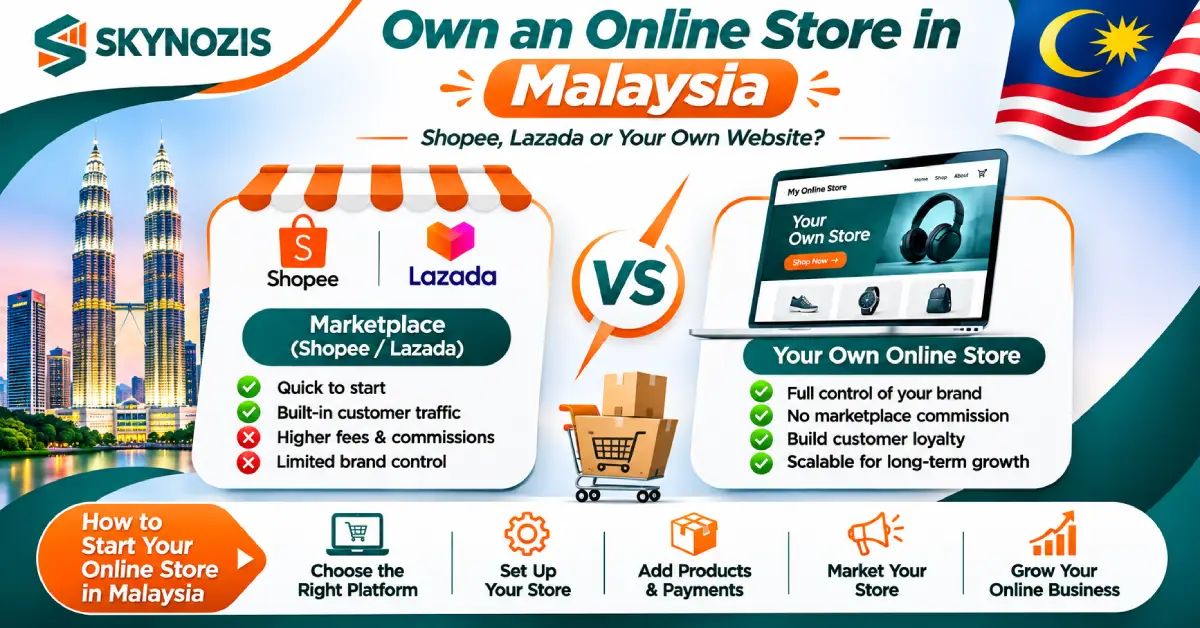
Unlike relying entirely on third-party marketplaces, having your own eCommerce website gives your business greater control over its website experience, product presentation and customer relationships.
2. Create Product Pages That Encourage Customers to Buy
Product presentation plays an important role in online shopping. Customers cannot physically touch or examine products before purchasing, so your website must provide enough information to help them make decisions.
Every product page should include:
- Clear product name and description.
- High-quality product photographs.
- Product pricing.
- Available sizes, colours or variations.
- Stock availability.
- Product specifications.
- Delivery and return information.
- Customer reviews where available.
For example, a clothing retailer should allow customers to select available sizes and colours before adding products to their shopping carts.
An electronics retailer may need detailed technical specifications, product warranties and downloadable product information.
A well-organised product catalogue also makes it easier for customers to browse different categories and discover relevant products.
Ready to Take Your Retail Business Online?
Turn your physical shop into a professional online shopping experience. Skynozis helps retailers build customised eCommerce websites with attractive product pages, shopping carts and secure payment integrations.
3. Integrate Online Payments and Make Checkout Convenient
A convenient checkout process is essential for an eCommerce website.
Customers should be able to review their selected products, confirm delivery details and complete payments without unnecessary complications.
Depending on your business requirements and payment provider, your online store can support:
- Online banking payments.
- Credit and debit cards.
- Supported digital wallets.
- Payment confirmation notifications.
- Order summaries and receipts.
- Secure checkout functionality.
For Malaysian retailers, payment gateway integration should consider the payment methods commonly used by their intended customers.
If you plan to sell products to Singapore customers, you should also consider supported payment methods, currency presentation and cross-border transaction requirements.
The payment process should be easy to understand, secure and transparent. Clearly display the total cost, including applicable delivery charges, before customers confirm their orders.
4. Manage Inventory, Orders and Deliveries Efficiently
Managing online orders alongside physical shop sales can become challenging when inventory information is maintained manually.
A properly configured eCommerce website can help retailers organise their daily operations.
Important features may include:
- Real-time stock availability, subject to inventory integration.
- Product stock management.
- Order management dashboard.
- Order status updates.
- Customer order history.
- Shipping and delivery integration.
- Automated order notifications.
For businesses operating both physical and online stores, inventory synchronisation can be particularly useful.
For example, when a product is sold through the physical shop, an integrated inventory system can update its online stock availability.
The exact functionality depends on the selected eCommerce platform and any required third-party integrations.
Retailers should plan these workflows before development to avoid unnecessary administrative work after launching their online store.
5. Optimise Your Online Store for Mobile Shopping
Many customers discover and browse products using smartphones.
If your website is difficult to navigate on mobile devices, customers may struggle to view product photographs, select variations or complete checkout.
A mobile-friendly eCommerce website should include:
- Responsive product layouts.
- Easy-to-use navigation.
- Readable product descriptions.
- Mobile-friendly shopping cart.
- Simple checkout forms.
- Optimised product images.
- Fast-loading pages.
Your website should provide a consistent experience across smartphones, tablets and desktop computers.
Need a Custom eCommerce Website for Your Retail Brand?
From WooCommerce development and customised product pages to payment gateway and inventory integrations, Skynozis builds eCommerce solutions around your business requirements.
Whether you’re launching your first online store or upgrading an existing website, let’s create a better shopping experience for your customers.
6. Use SEO to Help Customers Discover Your Products
Building an online store is only the first step. Potential customers must also be able to find your products through search engines.
Search engine optimisation helps your website attract relevant organic traffic.
Important eCommerce SEO practices include:
- Unique product page titles and meta descriptions.
- Descriptive product URLs.
- Proper product category structure.
- Product descriptions written for customers.
- Optimised product images and ALT text.
- Relevant internal links.
- Mobile-friendly website design.
- Product structured data where appropriate.
Retailers targeting different Malaysian markets can also create useful location-specific content based on their actual delivery coverage and business operations.
For example, businesses targeting Kuala Lumpur, Selangor, Penang and Johor Bahru can develop relevant content around their products, delivery services and customer needs.
If you are expanding into Singapore, ensure that your website clearly communicates applicable delivery arrangements, currency information and purchasing conditions.
Avoid creating duplicate location pages simply to insert city names. Every page should offer useful information.
7. Choose the Right eCommerce Platform for Your Business
Choosing the right platform is an important decision when moving your retail business online.
The ideal platform depends on your product catalogue, operational requirements, budget and future expansion plans.
WooCommerce is one option for businesses that want an eCommerce store built around WordPress. It supports product management, shopping carts, checkout functionality and a range of extensions.
A customised eCommerce solution may be more suitable when your business requires specialised pricing, advanced integrations, unique checkout workflows or additional administrative functionality.
Before starting development, consider:
- Number of products and categories.
- Required payment gateways.
- Inventory management requirements.
- Delivery and shipping arrangements.
- Customer account functionality.
- Marketing and analytics integrations.
- Future scalability.
A suitable platform should support your current business requirements while allowing room for future improvements.
Why Choose Professional Online Store Development?
Every retail business operates differently. A small boutique may need a straightforward online store, while a larger retailer may require advanced inventory management, multiple payment options and integrations with existing business systems.
Professional online store development Malaysia should therefore focus on your products, customers and operational requirements.
At Skynozis, we provide eCommerce website development, WooCommerce solutions, custom WordPress development, payment gateway integrations and tailored website functionality.
Our focus is on creating modern, responsive and user-friendly online stores that help businesses establish a stronger digital presence.
Whether you are a startup retailer, an established physical shop or a growing lifestyle brand, the right eCommerce website can provide a foundation for expanding your business online.
Frequently Asked Questions
An online store allows customers to browse products and place orders without visiting your physical premises. It also gives retailers an additional sales channel and greater control over their online shopping experience.
The cost depends on the number of products, website design, payment integrations, inventory requirements and custom functionality. A simple online store generally requires a smaller development scope than a fully customised eCommerce platform.
Yes. A WordPress website using WooCommerce can provide an administrative dashboard for managing products, stock, orders, customers and other store activities.
This depends on the selected payment gateway and its supported countries, currencies and transaction methods. These requirements should be confirmed before development.
Yes. WooCommerce can be suitable for small and growing retailers that need product management, shopping cart functionality, checkout and payment integrations.
Yes. Depending on the selected platform and integrations, an online store can support stock management, order tracking and delivery workflows.
Take Your Retail Business to the Next Level
Moving from a physical shop to an online store is an important step towards building a stronger digital presence.
A professional eCommerce website helps customers explore your products, place orders and interact with your brand more conveniently.
If you’re planning to launch an online store or upgrade your existing eCommerce website, Skynozis can help you develop a solution tailored to your retail business.
Ready to start selling online?
Visit https://skynozis.com/ or contact info@skynozis.com to discuss your eCommerce website project.