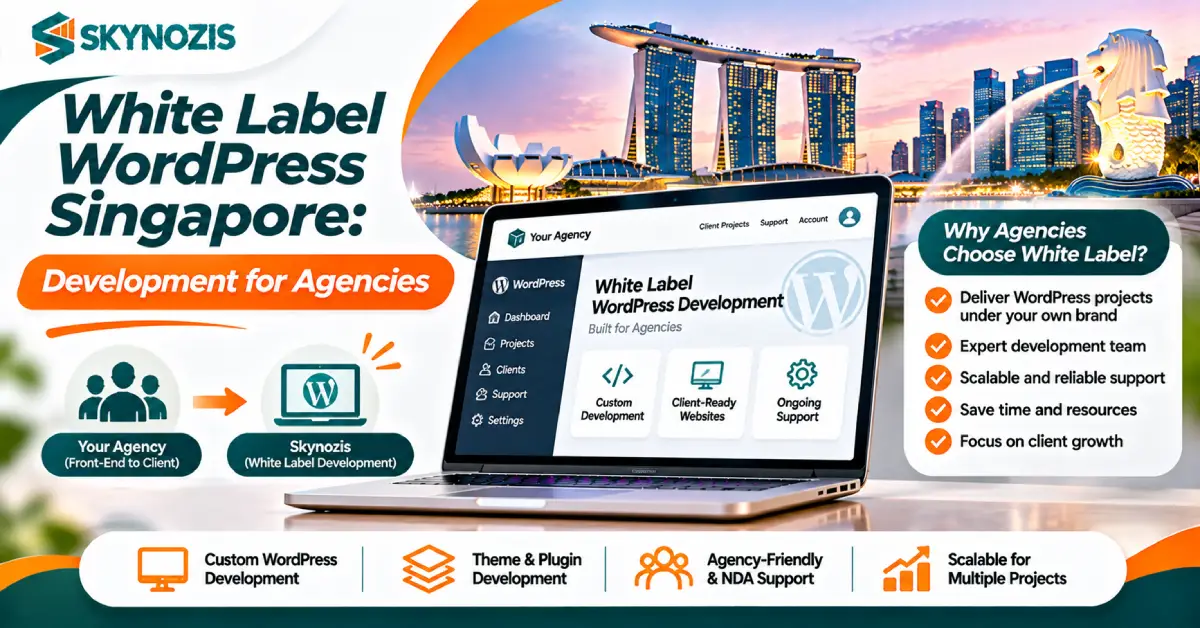
White label WordPress Singapore development services provide digital agencies with a flexible way to outsource website development while maintaining their own brand identity and client relationships. If your agency is managing multiple website projects, meeting tight deadlines or experiencing a shortage of internal developers, working with an external WordPress development partner can help increase your project capacity.
Instead of hiring additional full-time developers, your agency can outsource technical tasks such as custom WordPress development, Figma to WordPress conversion, Elementor development and WooCommerce implementation. In this guide, we explain how white-label development partnerships work and what Singapore agencies should consider before choosing a development partner.
1. What Is White-Label WordPress Development?
White-label WordPress development is a business arrangement where one development company builds or supports a website on behalf of another agency, without presenting itself as the primary service provider to the agency’s client.
For example, a Singapore-based digital agency may handle:
- Client communication
- Business requirements
- Website planning
- Design direction
- Project approvals
- Final client delivery
Meanwhile, its development partner handles the technical implementation, such as:
- WordPress installation and configuration
- Custom theme development
- Figma to WordPress conversion
- Responsive website development
- Plugin development
- Third-party integrations
- Testing and bug fixing
- Technical handover
The agency remains responsible for its client relationship and agreed project deliverables, while the development partner works within the agreed scope.
This arrangement allows agencies to accept suitable projects without completing every technical task internally.
2. Why Singapore Agencies Consider Outsourcing WordPress Development
Singapore agencies work with businesses across different industries, including professional services, retail, hospitality, education and technology.
Each client may require a different website structure, design approach and technical functionality.
When multiple projects run simultaneously, development capacity can become a challenge.
Here are some reasons agencies consider outsourcing WordPress development.
Manage Development Workload During Busy Periods
Your agency may have enough designers and project managers but limited development resources.
For example, you might receive three new WordPress projects while your existing developers are completing two ongoing builds.
Instead of immediately hiring additional staff, you can outsource suitable development tasks to an external partner.
This can help your agency manage temporary workload increases while keeping internal resources focused on other responsibilities.
Expand Services Without Hiring a Larger Team
A digital agency may receive requests for services outside its core technical capabilities.
For example:
- Custom WordPress themes
- Advanced Elementor development
- Figma to WordPress conversion
- WooCommerce development
- Custom plugin development
- Website redesign
- API integrations
Working with an experienced development partner can help you offer these services without hiring specialists for every technical requirement.
Focus on Client Relationships and Business Development
Agency owners often spend considerable time managing development tasks, reviewing code and resolving technical issues.
A structured white-label arrangement can reduce some of this operational workload.
Your internal team can focus more on:
- Client acquisition
- Marketing strategy
- Website design
- Project management
- Customer communication
- Business development
This does not remove your responsibility for quality assurance, but it can help distribute project responsibilities more effectively.
3. What WordPress Development Services Can You Outsource?
Not every agency needs to outsource an entire website project. You can work with a white-label developer for specific tasks or complete development projects.
Figma to WordPress Conversion
If your agency handles UI/UX design in Figma, you can outsource the conversion of approved designs into functional WordPress websites.
A typical workflow includes:
- Receiving the approved Figma design.
- Reviewing layouts and responsive requirements.
- Preparing the WordPress development environment.
- Converting designs into responsive pages.
- Implementing interactive elements.
- Testing the website across devices.
- Preparing the completed build for review.
The final result should reflect the approved design rather than relying on generic layouts.
Custom WordPress Theme Development
Agencies that regularly work with custom designs may require developers who can create tailored WordPress themes.
This can include:
- Custom page templates
- Reusable content sections
- Header and footer layouts
- Custom post types
- Theme options
- Responsive components
- Dynamic content management
Custom themes can provide greater flexibility when clients need unique website experiences.
Elementor Development
Many agencies use Elementor to create and manage WordPress websites.
Outsourcing Elementor development can help with:
- Custom page layouts
- Global design settings
- Responsive adjustments
- Reusable templates
- Dynamic content
- Custom CSS
- Third-party widget integrations
Before outsourcing, define which Elementor version, add-ons and licences the project requires.
WooCommerce Development
For agencies managing online store projects, WooCommerce development can involve more specialised functionality.
Possible tasks include:
- Product catalogue setup
- Custom product layouts
- Shopping cart customisation
- Checkout improvements
- Payment integrations
- Shipping configuration
- Product filtering
- Inventory-related functionality
The technical scope should be agreed before development begins.
Custom Plugin Development
Some client projects require functionality that cannot be efficiently delivered using existing plugins.
A white-label development partner may help build custom WordPress plugins for business-specific requirements.
These could include booking functionality, data integrations, custom dashboards or specialised website workflows.
Custom plugin work should include appropriate documentation, testing and maintenance considerations.
White-Label WordPress Development for Your Agency
Need Reliable WordPress Development Support for Your Singapore Agency?
Handle more website projects without putting additional pressure on your internal team. Skynozis provides custom WordPress development support for agencies that need help with website builds, Figma conversions and technical implementation.
Work with a development partner behind the scenes while your agency maintains its client relationships and brand identity.
4. How Does a White-Label Development Partnership Work?
A successful partnership needs a clearly defined workflow.
Without a structured process, outsourced development can create communication problems, missed deadlines and unnecessary revisions.
Here is an example of how a typical agency partnership can work.
Step 1: Your Agency Receives the Client Project
Your agency communicates with the client, understands the requirements and prepares the initial project scope.
You remain the primary point of contact.
Step 2: Share the Development Brief
You provide the development partner with the required information, such as:
- Figma design files
- Sitemap
- Page list
- Website functionality
- Content and images
- Technical requirements
- Reference websites
- Expected delivery timeline
A clear brief reduces assumptions and helps developers estimate the work accurately.
Step 3: Scope and Timeline Confirmation
The development partner reviews the requirements and confirms the technical approach, deliverables, dependencies and estimated timeline.
Any additional requirements should be discussed before development starts.
Step 4: Development on a Staging Site
The website is developed in a staging environment rather than directly on the client’s live website.
This allows the agency to review the work and request agreed changes without disrupting the existing website.
Step 5: Testing and Quality Assurance
The completed website should be checked for:
- Responsive layouts
- Navigation and links
- Contact forms
- Website functionality
- Browser compatibility
- Loading performance
- Basic security configuration
- Content display
The agency should also perform its own review before presenting the project to its client.
Step 6: Handover and Final Delivery
Once the website is approved, the development partner provides the agreed files, access details and technical documentation.
Your agency can then complete the final client handover under its own brand.
5. What Should Singapore Agencies Look for in a White-Label WordPress Partner?
Choosing a development partner is an important business decision. The partner’s technical work directly affects your agency’s reputation and client relationships.
Consider the following factors before entering a partnership.
WordPress Development Experience
Review the developer’s experience with custom WordPress themes, page builders, WooCommerce, responsive design and custom functionality.
Ask for examples of relevant projects rather than relying only on general claims.
Ability to Follow Figma Designs
If your agency provides Figma designs, the development partner should understand design specifications, spacing, typography, components and responsive behaviour.
The ability to follow design files accurately is especially important for agencies that sell custom website design services.
Communication and Time-Zone Compatibility
Singapore and Malaysia share the same time zone, which can make regular project communication and working meetings easier.
However, time-zone compatibility alone does not guarantee smooth delivery.
Agree on communication channels, working hours, progress updates, review periods and escalation procedures.
NDA and Confidentiality
A white-label relationship often involves access to client information, project files and business requirements.
A non-disclosure agreement (NDA) can establish confidentiality obligations.
The agreement should explain how client information, credentials, design files and project materials will be handled.
Service-Level Agreement (SLA)
A service-level agreement can define the operational expectations of the partnership.
It may cover:
- Communication response times
- Project milestones
- Delivery expectations
- Bug-fixing responsibilities
- Support arrangements
- Escalation procedures
- Revision scope
Avoid relying on vague promises. Define measurable expectations that both parties can realistically meet.
6. Fixed-Price Projects vs Hourly Development: Which Is Better?
When outsourcing WordPress development, you may encounter fixed-price and hourly pricing arrangements.
Both approaches can work, but the right choice depends on the project requirements.
Fixed-Price Development
A fixed-price agreement defines the development scope and agreed price before work begins.
This approach can be useful for projects with clearly documented requirements.
Examples include:
- Five-page business websites
- Figma to WordPress conversions
- Website redesign projects
- Defined WooCommerce builds
- Custom landing pages
The advantage is that your agency can understand the expected development cost before committing to the project.
However, major changes outside the approved scope may require a separate quotation.
Hourly Development
Hourly development is generally more suitable for ongoing work, uncertain requirements or tasks that cannot be accurately scoped in advance.
Examples include:
- Existing website troubleshooting
- Ongoing technical support
- Development improvements
- Complex debugging
- Small feature enhancements
For hourly arrangements, clarify how time is tracked, how work is reported and whether prior approval is required for additional hours.
Which Model Should Your Agency Choose?
For clearly defined client website projects, fixed-price development may make project budgeting easier.
For ongoing technical assistance and changing requirements, an hourly arrangement may provide more flexibility.
Some agencies use both models depending on the type of work.
7. How to Protect Your Client Relationships When Outsourcing
Outsourcing does not mean giving up control of the client experience.
Your agency should remain responsible for the relationship, communication and final approval process.
Here are some practical measures.
Keep Client Communication Centralised: Decide whether the development partner communicates directly with your agency only or has an approved role in client meetings.
Use Clear Project Documentation: Share written requirements, design files, feedback and approval records.
Define Confidentiality Requirements: Use suitable agreements to protect client information and business materials.
Control Access Permissions: Provide only the access needed to complete the assigned work. Use secure credential-sharing arrangements rather than sending passwords through ordinary messages.
Maintain a Quality Assurance Process: Review completed work before presenting it to the client.
Document Ownership and Licensing: Clarify the rights to custom code, design assets, plugins and third-party software.
These practices help maintain a professional white-label relationship and reduce unnecessary project risks.
Start a White-Label WordPress Development Partnership
Looking for a Development Partner for Your Next Agency Project?
Expand your agency’s development capacity with custom WordPress development support from Skynozis. Whether you need help with a single website build, Figma-to-WordPress conversion or ongoing development requirements, we can discuss a suitable project arrangement.
Start with a clearly defined trial project and evaluate the working process before planning a longer-term partnership.
8. Common Mistakes to Avoid When Outsourcing WordPress Development
Even a technically capable development partner can become difficult to work with if the project is not managed properly.
Avoid these common mistakes.
- Starting development without a complete brief.
- Selecting a developer based only on the lowest quotation.
- Not defining revision limits.
- Failing to confirm the staging and production environments.
- Sharing unnecessary client credentials.
- Ignoring source code ownership.
- Not documenting the NDA and confidentiality arrangements.
- Promising clients delivery dates before confirming development capacity.
- Skipping testing and quality assurance.
- Failing to define support after project completion.
A good partnership requires more than technical development skills. It needs clear processes, realistic expectations and consistent communication.
9. Start With a Small Trial Project Before Building a Long-Term Partnership
If you have never worked with a particular white-label developer, it may be sensible to begin with a small, clearly defined project.
A trial project allows your agency to evaluate:
- Understanding of technical requirements
- Figma design accuracy
- Code quality
- Communication
- Delivery management
- Revision handling
- Documentation
- Handover quality
You could start with a landing page, a small business website or a defined Figma-to-WordPress conversion.
Agree on the scope, price, timeline and acceptance criteria before starting.
After completing the trial, review the results with your internal team and decide whether the partnership is suitable for future projects.
Frequently Asked Questions
White-label WordPress development is an arrangement where an external development company builds or supports websites on behalf of another agency. The agency maintains its client relationship and delivers the completed work under its own brand, subject to the agreed contract.
Agencies may outsource development to manage overflow work, access specialised technical skills, reduce recruitment requirements and handle additional website projects without immediately expanding their internal team.
Yes. You can provide approved Figma designs, responsive requirements and project documentation to a white-label development partner for implementation in WordPress.
That depends on the agreed working arrangement. In a traditional white-label model, the agency manages client communication while the development partner communicates with the agency. Any direct client interaction should be approved in advance.
An NDA can help establish confidentiality obligations when sharing client information, designs, credentials and project materials. You should also consider appropriate contractual terms covering data protection, access permissions and intellectual property.
An SLA, or Service-Level Agreement, defines agreed service expectations. It can cover response times, delivery milestones, communication, bug fixes, support responsibilities and escalation procedures.
Fixed-price development is useful when the project scope is clearly defined. Hourly development may be more suitable for ongoing support, troubleshooting and changing requirements. The right model depends on the project.
Review their WordPress experience, previous projects, Figma conversion skills, communication process, technical documentation, confidentiality practices and ability to meet agreed project requirements.
Build a Reliable White-Label Development Partnership
White-label WordPress development can help Singapore agencies manage additional projects, access specialised technical skills and expand their service capacity without immediately building a larger internal development team.
However, a successful partnership requires more than finding someone who can build a website. You need a development partner who understands agency workflows, follows technical requirements, respects client confidentiality and delivers work within an agreed scope.
Before starting a long-term arrangement, evaluate the developer’s portfolio, communication process, NDA, SLA, staging workflow, code ownership and handover procedures. Starting with a small trial project can help you assess whether the working relationship is suitable.
At Skynozis, we provide WordPress website design and development support for agencies that need a reliable technical development partner.
If your Singapore agency is looking for additional WordPress development capacity, discuss your next project with Skynozis and explore a suitable white-label working arrangement.